
Diploma vs Degree: What’s the Right Path After SPM?
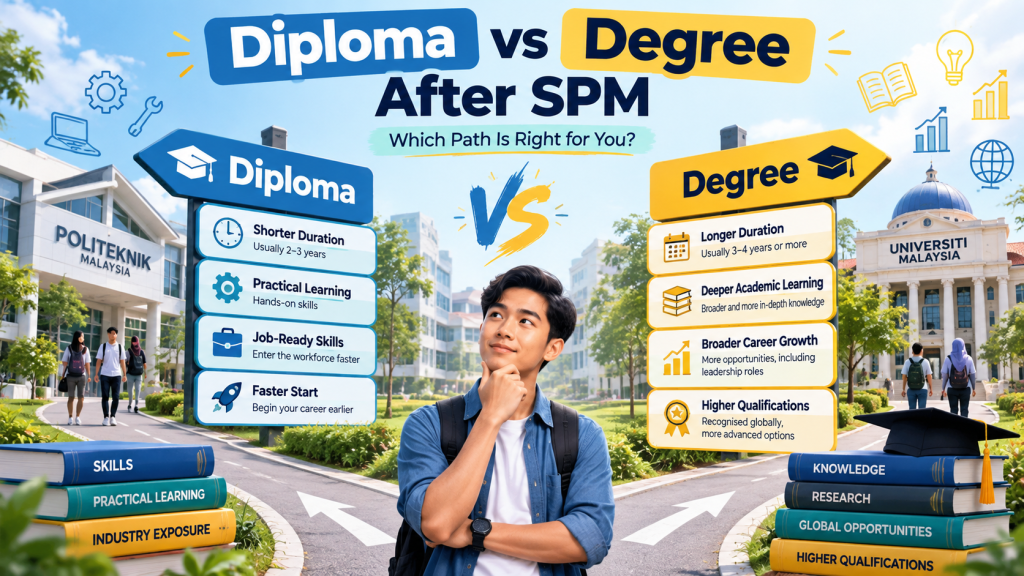
SPM results come out, and within a week every parent in the family WhatsApp group has an opinion about what happens next. Some swear by the diploma route because a cousin did it and landed a decent job. Others insist a direct degree saves time and money in the long run. The honest answer is that the diploma vs degree after SPM decision depends less on which path is “better” and more on your child’s SPM results, budget, and what they actually want to study — and those three things don’t always point the same direction.
This guide walks through both routes properly, with real numbers, so you’re deciding from facts rather than from what your neighbour’s son did.
What a diploma programme actually looks like
A diploma in Malaysia typically runs two to three years, depending on the field. Business and IT diplomas tend to sit at the shorter end, around two to two-and-a-half years, while diplomas with a clinical or lab component — pharmacy, nursing, culinary arts — often stretch closer to three years because of practical hours and internships.
Entry is more forgiving than most parents expect. Many private colleges accept students with just three credits in SPM, sometimes without needing a pass in a specific subject beyond the basics, though accounting, engineering and health-science diplomas usually ask for a credit in Mathematics and the relevant science subject. UEC holders are widely accepted too, and STPM or A-Level students sometimes enrol in a diploma if their results fell short of direct degree entry at their target university.
What surprises people is how practical these programmes are. A diploma in culinary arts at a college like Taylor’s or Sunway will have students in a working kitchen within the first semester, not just reading textbooks. That hands-on exposure is exactly why employers in hospitality, IT support and accounting technician roles often prefer diploma graduates with real project experience over degree holders with none.
Going straight for a degree: what it takes
Direct entry into a bachelor’s degree — whether through Foundation, A-Levels, STPM or matriculation — asks for more upfront. Most local private universities want at least five credits in SPM including Bahasa Malaysia and English, plus a decent Foundation or STPM result (typically CGPA 2.50–3.00 depending on the course and university). Competitive programmes like actuarial science, pharmacy or medicine push that bar higher, often CGPA 3.30 and above, alongside subject-specific requirements like a credit in Additional Mathematics or Chemistry.
The appeal is obvious: no need to sit through a separate diploma before starting degree-level content, and the whole journey to a bachelor’s finishes in three to four years instead of the five to six years a diploma-then-degree route can take if not planned carefully. But it also means committing RM 90,000 to RM 150,000 or more (for a full local private degree in business, engineering or IT) without the safety net of an exit qualification if things don’t work out along the way.
The full cost picture, not just year one
This is where families get caught out — comparing the first-year diploma fee against the first-year degree fee, instead of the whole journey.
A diploma alone typically costs RM 25,000 to RM 45,000 over two to three years at a private college. If your child then transfers into a related bachelor’s degree — which most diploma holders do — that adds another RM 45,000 to RM 70,000 for the remaining degree years, since diploma credits usually cover the first year of a related degree. Total: often RM 75,000 to RM 110,000, spread across five to six years.
A direct degree, by contrast, runs RM 90,000 to RM 150,000+ over three to four years in one continuous stretch, with a heavier fee burden in the early years since there’s no diploma-length runway to spread the cost.
So the diploma-then-degree path isn’t automatically cheaper — but it does spread the financial burden over a longer period, which matters a lot for families paying as they go rather than drawing down a lump sum of savings. It’s a cash-flow decision as much as a total-cost one.
What diploma holders actually go on to do
Diploma holders in Malaysia aren’t stuck at entry-level forever, and the “diploma is a dead end” idea doesn’t hold up in most fields. Accounting technicians with a diploma from an ACCA-accredited college regularly earn RM 2,800 to RM 3,800 starting out, and many sit for professional papers alongside working, reaching supervisory roles within four to five years without ever completing a full degree.
That said, the ceiling is real in more regulated professions. Engineering, architecture and any field requiring registration with a professional body (BEM, LAM, MMC) essentially requires a recognised degree — a diploma alone won’t get you registered as a Professional Engineer, however good the on-the-job experience. If your child is aiming at law, medicine, engineering or architecture specifically, the diploma route is a detour, not a shortcut, and should only be used deliberately, as a stepping stone with a clear transfer plan.
Bridging from diploma to degree
This is the part that makes the diploma route work well when it’s planned properly. Most Malaysian private universities offer credit exemption for diploma holders moving into a related bachelor’s — commonly one to one-and-a-half years’ worth of exemption for a business, IT or hospitality diploma feeding into the matching degree at the same institution or a partner one.
The catch is “related.” A diploma in Culinary Arts won’t get exemptions into a Computer Science degree. And CGPA still matters at this transfer point — most universities want at least a 2.75 to 3.00 diploma CGPA to guarantee a smooth transfer, higher for competitive programmes. Students who coast through their diploma years sometimes find the degree door narrower than they expected when results season comes around.
A quick checklist before deciding
Before locking in either path, it helps to sit down with your child and go through a short list rather than deciding off gut feeling:
- What were the actual SPM results, subject by subject — not just the overall grade count?
- Does the target career (engineering, medicine, law, architecture) legally require a degree, or is it open to diploma-qualified professionals with experience?
- What’s the realistic annual budget, and does the family need the cost spread over more years or want it concentrated and done?
- Is your child ready for university-level academic pace now, or would a more structured, smaller-class diploma environment suit them better first?
- If starting with a diploma, which specific degree and university will it transfer into, and what CGPA does that transfer require?
Frequently asked questions
Can a diploma holder still get into a top university for their degree? Yes. Universities like UM, Sunway, Taylor’s and Monash Malaysia all accept diploma holders into relevant bachelor’s programmes with credit exemptions, provided the diploma CGPA meets the entry bar, usually 2.75 and above.
Is a diploma looked down on by employers compared to a degree? Less than people assume, especially in accounting, IT support, hospitality and creative fields where practical skills and certifications (like ACCA papers or software certifications) often matter more than the qualification level alone. For regulated professions, a degree is non-negotiable.
How much time do you actually save with a direct degree instead of diploma-then-degree? Roughly one to two years, since diploma students typically get partial credit exemption but rarely full first-year coverage. If speed matters more than spreading costs, direct degree entry is usually faster.
What if my child doesn’t get the SPM results needed for direct degree entry? A diploma is the standard fallback and a legitimate one — it’s not a lesser path, just a different runway. Foundation programmes with lower entry bars are another option worth comparing before committing.
Talk to someone before you commit
Every family’s numbers and priorities look different, and the right call for one child studying accounting is rarely the right call for another aiming at engineering. If you want to see this mapped against your child’s actual SPM results and the courses they’re genuinely interested in, GoUni’s course-matching tool is a good place to start — it’s free, and it’s built exactly for this kind of decision.